



Table of Contents

Share with your community!

AI in the Workplace:

Balancing Security While Boosting Productivity

Table of Contents

When was the last time you drafted an email entirely on your own?
The last time you wrote a full set of code without any help?
Or created a business report from scratch?
For many of us, it has been a while.

We now rely on AI tools far more than we ever expected. Just three or four years ago, you would not have believed that so much of your work could be done with the click of a button. That shows how quickly these tools have become part of our daily routine. AI certainly has a productive and helpful side. It allows us to move faster, stay efficient, and focus on bigger goals. But it also has a side that is not as secure. This is where the risks come in. Privacy and data security concerns, bias and fairness issues, intellectual property challenges, and legal and compliance risks are all part of the picture.

In this newsletter, we will start by looking at privacy and data security risks and then explore what counts as acceptable and unacceptable usage of AI in the workplace.

Privacy and Data Security Risks: The Hidden Side of AI

AI thrives on data. The more information it receives, the smarter and more capable it becomes. But here is the other side of the story. Every email you draft, every client report you upload, and every meeting transcript you share can turn into fuel for AI systems. Once that data is out there, you may lose control over where it goes or how it is used.

The Data Hunger Problem

Many AI tools need large amounts of data to function well. What feels like a simple upload of a document or a short note can, in fact, add to an enormous pool of information the system stores and learns from. The danger is that data you never intended to leave your desktop could end up being collected, analyzed, or even repurposed in ways you did not expect.

Beyond the Original Purpose

You may believe that asking AI to “summarize this file” means it will do only that. In reality, the same data may be reused for purposes you were never told about. This is called purpose creep, where information collected for one reason ends up being used for something completely different, often without your knowledge or consent.

The Myth of Anonymity

Many people assume that anonymized data is safe. The truth is that AI can often piece together small fragments of information and re-identify individuals. Something as ordinary as a location stamp or a browsing pattern can, when combined with other details, reveal a person’s identity. This puts both employees and customers at risk of having their privacy compromised.

The Breach You Never See Coming

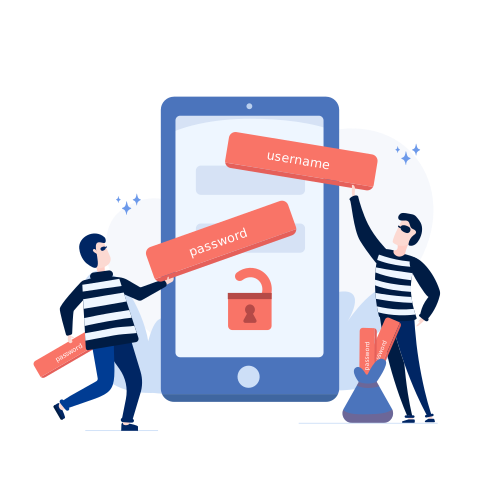
Perhaps the most serious risk is losing control of sensitive information. Once data is entered into public AI platforms, it often sits on servers outside the company’s control. If those servers are hacked or misused, confidential business strategies, trade secrets, or personal details of employees and customers could be exposed.

Smart AI Practices in the Workplace

To keep AI helpful and safe, here are some practices every employee should follow.

Use Approved Tools

Always work with AI tools that your organization has reviewed and approved. Not every platform is designed with the same level of security. Some may be safe for tasks like drafting text or assisting
with coding, while others should only be used for public data. If you are unsure, check which tools are considered safe before using them.

Weak home network becomes the back door

Protect Sensitive Data

Do not feed confidential information into public AI platforms. This includes customer details, employee records, financial data, and any part of your company’s secret strategy. Once this information leaves your control, you cannot guarantee how it will be stored, shared, or reused.

Device theft on public transport

Stay Accountable

If you notice AI being misused, whether by accident or on purpose, it is important to raise the concern. Sometimes a colleague simply needs more training or a reminder about best practices. In other cases, reporting quickly can prevent serious data breaches or compliance issues.

No MFA turns one old password into a breach

Refresh Your Knowledge Regularly

AI tools evolve quickly. A practice that feels safe today may carry risks tomorrow. Make it a habit to stay informed about the latest internal guidance and participate in regular training sessions or updates.

Public WiFi evil twin harvests logins

Keep Privacy Laws in Mind

Remember that laws such as GDPR, HIPAA, or CCPA still apply when AI is used. Even if a tool feels private, your inputs may be stored on external servers. Always treat protected data with care
and never assume that AI use overrides legal obligations.

The CIA triad min scaled

Final Thoughts

Artificial intelligence is here to stay, and it will continue to shape the way we work.
When used carefully, it helps us save time, improve efficiency, and open new opportunities for creativity and problem solving. When used carelessly, it can expose sensitive information, damage trust, and create risks that are difficult to undo.

The key is balance. By being aware of the risks, following safe practices, and treating AI
as a supportive assistant rather than a replacement, we can ensure it serves us well. Each of us has a role to play in protecting data, respecting privacy, and using AI responsibly. When we do this, we build a workplace where innovation and security go
hand in hand.

Share with your community!

Read More: Download the Full Insight

Let’s Build Digital Excellence Together

Build & scale AI models on low-cost cloud GPUs.

Related Services

Related Posts

AI in the Workplace: Balancing Security While Boosting Productivity

AI in the Workplace: Balancing Security While Boosting Productivity

Table of Contents Share with your community! Home Blog AI in the Workplace: Balancing Security

January 29, 2026
McLaren X KDEM

McLaren X KDEM

McLaren X KDEM Episode 3 – with Sanjeev Gupta, Anoj Pillai & Bill Goodridge In

January 7, 2026
Reimagining Investment Banking with AI: From Market Risk to Regulatory Compliance

Reimagining Investment Banking with AI: From Market Risk to Regulatory Compliance

Table of Contents Share with your community! Home Blog Reimagining Investment Banking with AI: From

October 27, 2025

Download Whitepaper Retail Fraud